Guide
Cold Walls, High Bills: How Insulation Batts and Reflective Foils Cut Winter Heating Costs
You put the heater on at six. By nine the room still feels cold, the bill is climbing, and the wall you are sitting next to is noticeably cooler than the air. That is not a heater problem. That is the wall giving your heat away as fast as you make it.
Overview
You put the heater on at six. By nine the room still feels cold, the bill is climbing, and the wall you are sitting next to is noticeably cooler than the air. That is not a heater problem. That is the wall giving your heat away as fast as you make it.
Wall insulation is the layer that decides how much of what you pay for stays inside. Get it right and a modest heater keeps a room comfortable. Get it wrong, or leave gaps in it, and you are effectively heating Osborne Park.
Why Walls Matter More Than People Expect
Most people insulate the ceiling and stop. That is a sensible first move, because heat rises and a roof space is the easiest place to get to. But once the ceiling is done, the walls become the largest uninsulated surface in the house, and in winter they are in direct contact with the cold.
Walls also work on you in a way the ceiling doesn't. Sit next to a cold wall and your body radiates heat towards it, so the room feels colder than the thermostat says. People respond by turning the heating up, which widens the temperature difference across the wall and pushes even more heat out through it.
Good wall insulation breaks that loop. The inside face of the wall stays closer to room temperature, the room feels warmer at the same setting, and the heater runs less. That is the whole case for wall insulation in one sentence.
How Wall Insulation Actually Works
Heat leaves a wall three ways, and different products handle different ones:
That is the whole reason both product families exist. Batts and foils are not competing answers to the same question. They handle different halves of the problem, and wall insulation that only addresses one of them is only doing half the job.
- Conduction , heat travelling through solid material. Bulk insulation such as batts slows this by trapping air in fibres.
- Convection , warm air moving through gaps and cavities. This is defeated by fitting insulation snugly and sealing the obvious leaks.
- Radiation , heat crossing an air gap as infrared. Bulk insulation does little here; reflective foil is the product that addresses it.
Batts: The Workhorse of Wall Insulation
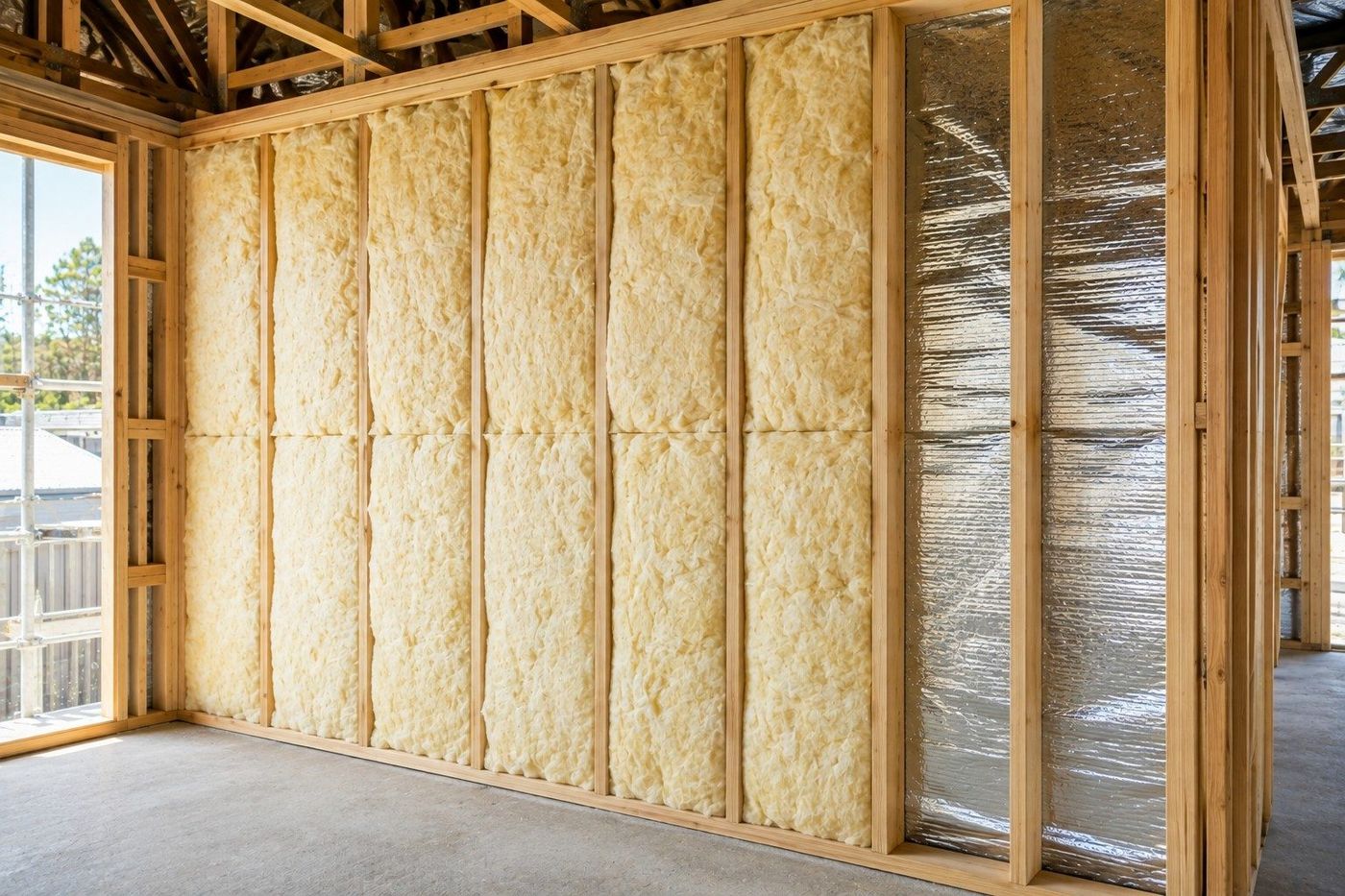
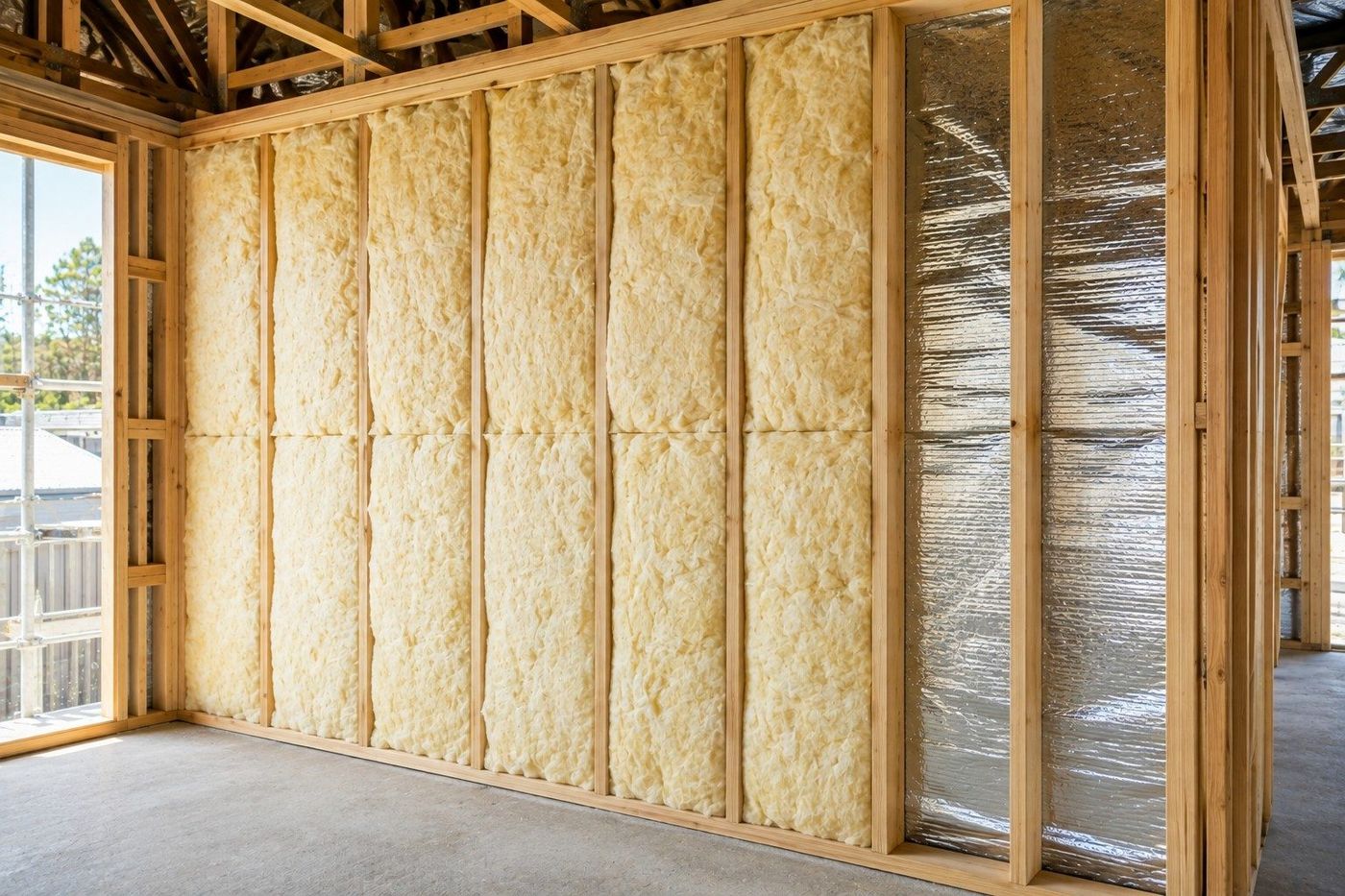
Insulation batts, glasswool, polyester or rockwool, sit between the studs and slow conducted heat. They are rated by R-value: higher R means more resistance to heat flow. For a typical framed external wall in Perth you are generally looking at the R2.0 to R2.7 band, depending on cavity depth and what the rest of the build-up is doing.
The R-value on the packet, though, is the value of a batt installed properly. It assumes the batt fills the cavity edge to edge, with no compression and no gaps. In practice that is where most of the performance is lost:
A wall with 10% of its area uninsulated does not lose 10% of its performance, it loses considerably more, because the heat concentrates through the gap. With wall insulation, careful fitting is worth more than a higher R-value installed badly.
- Batts cut short, leaving a gap at the top or bottom of the stud bay
- Batts squashed behind pipes and cables instead of split around them
- Bays skipped entirely behind a bath, a shower recess or a meter box
- Batts left slumped in the cavity, sagging away from the top plate over time
- Gaps around window and door openings where a full batt won't fit
Reflective Foils: The Other Half
Reflective foil insulation works on radiant heat rather than conducted heat. A low-emissivity foil surface facing an air gap reflects infrared back the way it came, which is why the air gap is not optional, a foil pressed flat against cladding or lining does almost nothing.
In a Perth winter the foil layer keeps radiant heat inside; in summer the same layer keeps a great deal of roof and wall heat out. That dual benefit is why reflective sarking is so common in WA construction, and why it is worth specifying properly rather than treating it as a builder's wrap.
Our foils and membranes range covers reflective sarking, wraps and liners. Some products combine a reflective face with a vapour-permeable membrane, which lets one layer handle radiant heat and moisture management at the same time, useful when cavity depth limits how much wall insulation you can fit.
Batts or Foil, or Both?
For most Perth homes the answer is both, in the right order. The foil layer sits behind the cladding facing a cavity; the batts sit between the studs behind it; the lining goes on last. Each one is doing a job the other cannot.
Where you have to choose, the decision usually comes down to the wall:
- New framed wall with a decent cavity , batts plus reflective sarking. This is the standard and the best value.
- Re-cladding an existing house , the wall is open, so do both while you can. You will not get another chance this cheaply.
- Shallow cavity or a lost-space problem , a rigid insulation board can deliver more performance per millimetre than a batt.
- Internal walls for warmth , usually not worth it thermally, though batts in internal walls are excellent for sound.
Where the Heat Really Escapes
Even a well-insulated wall leaks heat where the insulation stops. Studs, noggings, lintels and steel framing all conduct heat straight past the batts, these are cold bridges, and they show up in winter as vertical damp stripes on the lining that follow the framing.
A continuous layer of rigid board or reflective sarking across the face of the frame is what closes them. It is the difference between insulating between the framing and insulating the wall. On a heavily framed or steel-framed wall, that continuous layer can matter more than the R-value of the batts behind it, and it is the part of a wall insulation spec most often left out.
Air leakage does the rest. Gaps around windows, unsealed service penetrations, an uninsulated garage wall and open wall-to-ceiling junctions will undo good wall insulation quietly and constantly.
What It's Actually Worth
We are a supplier, not an energy assessor, so we will not put a number on your bill. What we can say is where the value sits, and it is more than the heating cost alone:
The Australian Government's YourHome guide to insulation is a good independent starting point if you want to understand R-values and climate zones before you specify.
- Comfort at a lower setting. Warmer wall surfaces mean the room feels right without cranking the thermostat.
- Fewer cold spots. Even temperatures across a room, rather than one wall everybody avoids sitting near.
- Less condensation. Warmer internal surfaces stay above dew point, which is the main defence against damp and mould on wall linings.
- Year-round benefit. The same layer that holds heat in during July keeps it out in January.
- Quieter rooms. Bulk insulation in a wall cavity reduces airborne noise as a side effect.
Wall Insulation Mistakes We See Every Winter
The products on site are usually fine. What goes wrong is nearly always the install, and it is the same short list every year:
None of that shows once the lining is on, which is exactly why it happens. If you are project-managing your own build, walk the wall insulation before the plasterboard goes up, it is the last moment you can see it.
- Foil with no cavity. Reflective sarking pulled tight against the cladding, so the air gap it needs to work has been squeezed out.
- Batts stuffed rather than fitted. Compressing a batt into a narrow bay lowers its R-value; splitting it around services keeps the rating.
- The last bay left out. Odd-width bays at corners and around openings get skipped because a full batt will not fit, and nobody cuts one down.
- Wall insulation stopping at the top plate. Leaving the wall-to-ceiling junction open lets warm air run straight out of the room into the roof space.
- Nothing behind the shower or the meter box. Awkward spots get skipped, and they are usually on an external wall.
- Downlights and penetrations unsealed. Every hole is an air path that bypasses the insulation entirely.
New Build vs Retrofit
On a new build, wall insulation is nearly free in relative terms. The frame is open, the trades are already there, and the difference between adequate wall insulation and good wall insulation is a small line on the materials list.
On an existing house it is harder, because the wall is closed. The practical options are:
If the ceiling is still on your list, our pre-winter R-value checklist covers that side, and our guide to energy efficient wall systems goes deeper on how the whole assembly performs together.
- Wait for the wall to open. Re-cladding, a bathroom renovation or a repair is the moment to insulate properly. Plan for it rather than being surprised by it.
- Do the accessible surfaces first. Ceiling insulation and the garage or laundry wall are usually far cheaper per unit of comfort than opening a lined external wall.
- Line over the top. An insulated lining board fixed to the inside face adds performance without removing the cladding, at the cost of a little floor area.
- Fix the air leaks. Sealing gaps costs very little and often delivers a noticeable improvement on its own.
A Sensible Wall Insulation Spec for a Perth Home
If you want a starting point to price rather than a research project, this is what we would put on a quote for a standard framed external wall in the metro area:
That combination handles conduction, radiation, air movement and cold bridging in one pass, which is what a wall insulation specification is supposed to do. Anything less and you are relying on the heater to make up the difference.
- Reflective, vapour-permeable sarking across the face of the frame, behind the cladding, with a maintained air gap
- Bulk insulation batts to suit the cavity depth, friction-fitted with no gaps or compression
- Continuous rigid board where framing is heavy, steel, or where cavity depth is tight
- Insulation batts in internal walls around bedrooms and bathrooms for acoustic benefit
- Sealed service penetrations and a properly detailed wall-to-ceiling junction
FAQ
What R-value do I need for walls in Perth?
For a typical framed external wall the common range is R2.0 to R2.7, set by cavity depth as much as anything. The NCC requirement depends on your climate zone and the rest of the build-up, so confirm against your plans rather than a rule of thumb.
Does reflective foil work without an air gap?
Barely. Reflective insulation relies on radiating across a gap. Pressed flat against cladding or lining it loses almost all of its benefit, so the cavity has to be maintained.
Can I add wall insulation without removing the cladding?
Sometimes. Blown-in products suit some cavities, and an insulated lining board can be fixed to the inside face. Both have trade-offs, and neither is as effective as insulating an open wall.
Will insulating my walls stop condensation?
It removes the biggest cause, which is a cold internal surface. You still need extraction in wet rooms and a wall build-up that can dry outward, or moisture will find the next coldest spot.
Are batts or rigid boards better?
Batts are better value where you have cavity depth to fill. Rigid boards give more performance per millimetre and can run continuously across the framing to close cold bridges. Plenty of walls use both.
Does wall insulation help with noise?
Yes, as a useful side effect. Bulk insulation in a stud cavity reduces airborne sound transfer, which is why it is worth putting batts in internal walls around bedrooms even though there is no thermal case for wall insulation there.
We Can Help
Aussie Plasterboard supplies insulation batts, rigid boards, reflective sarking and vapour-permeable wraps, plus the linings and compounds that finish the wall. Tell our Osborne Park team the wall build-up and what it has to achieve and we will help you specify it, or request a quote and we'll get it on a truck.