Guide
Plan Ahead: The Pre-Winter Building Materials Checklist for Perth Builders and Owner-Builders
A pre-winter building checklist is not admin for its own sake. It is the difference between a smooth site sequence and a week lost waiting on materials after the weather turns, and in Perth the weather turns fast.
Overview
A pre-winter building checklist is not admin for its own sake. It is the difference between a smooth site sequence and a week lost waiting on materials after the weather turns, and in Perth the weather turns fast.
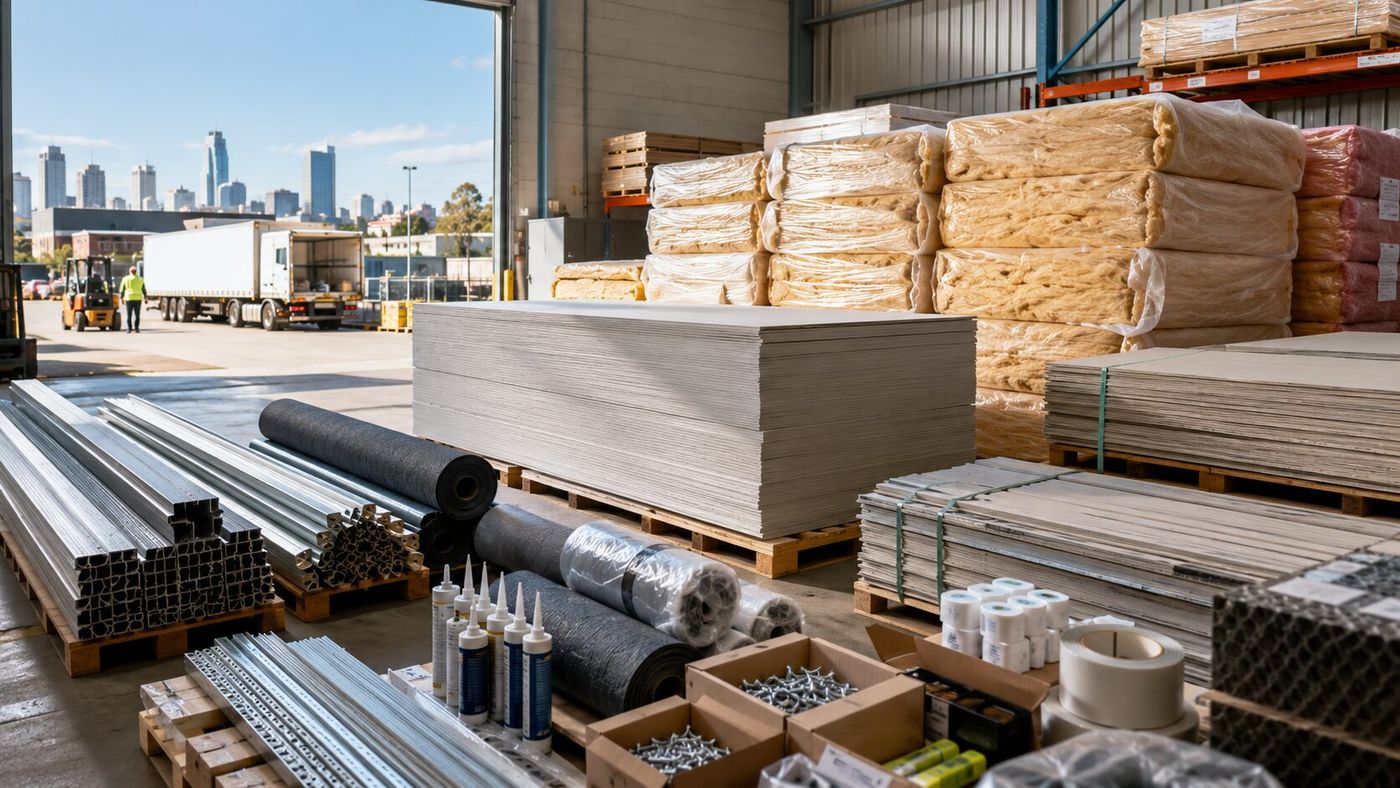
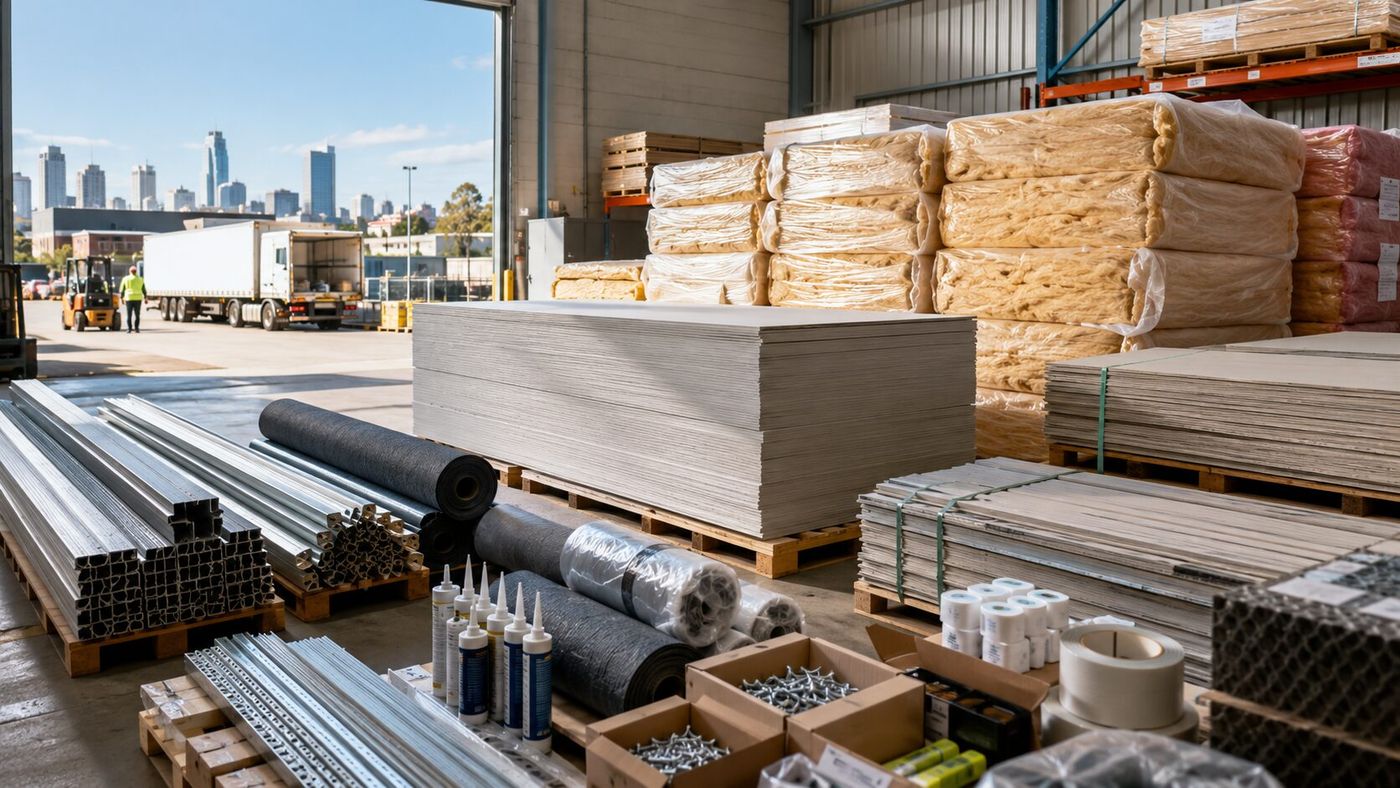
Winter changes access, delivery timing, storage, moisture exposure and trade coordination all at once. Plasterboard, insulation, foils, membranes, fibre cement, compounds, fixings, beads, access panels and ceiling materials all have to arrive at the right stage. Ordering the main sheets but forgetting the finishing system or the wet-area lining slows a job just as effectively as not ordering enough board. A good pre-winter building checklist catches all of it in one pass.
Why the Order You Place in Autumn Decides Your Winter
Three things change once the rain sets in, and each one belongs on the pre-winter building checklist because each is far easier to plan for than to react to:
A pre-winter building checklist done in autumn is really a scheduling tool. It converts a pile of decisions you would otherwise make under pressure into a single order conversation. Treat the pre-winter building checklist as a schedule, not a shopping list.
- Access gets harder. Soft ground, restricted crane and truck access, and a site that takes longer to move around. Deliveries that were simple in March become a scheduling problem in July.
- Materials have to be stored properly. Plasterboard left exposed or stacked on wet ground is scrap. Winter deliveries need somewhere dry and flat before they arrive, not after.
- Lead times stretch. Everyone in the metro area has the same idea in April. The specialty items, fire-rated board, particular sheet sizes, specific membranes, are the ones that run out first.
1. Confirm the Internal Linings
Start with the plasterboard schedule, because everything else sequences around it. Work through the plans room by room and confirm:
Everything else on the pre-winter building checklist sequences off this schedule, so it is worth getting settled first.
Builders will have this off the drawings. Owner-builders should ask for help translating room types into board requirements, bathrooms, laundries, garages, party walls and high-use spaces all behave differently. Our plasterboard range covers the options.
- Standard plasterboard for dry areas, with sheet size and thickness locked in
- Moisture-resistant board for wet or humid internal areas
- Fire-rated or acoustic board wherever the specification calls for it
- Ceiling board requirements, which are often a different thickness to the walls
- Sheet lengths against your access constraints, a sheet you cannot physically get into the room is a problem discovered on delivery day
2. Get the Wet-Area Boards Right
This is the single most common false economy on a pre-winter order. Standard board in a bathroom or laundry saves very little and shows up as mould within a couple of winters.
Our wet-area lining comparison works through which board belongs where. Add sealant for the cut edges to the same order, a moisture-resistant sheet with raw edges is only half the job. Wet-area board belongs near the top of any pre-winter building checklist, because it is the item that causes the most expensive rework when it is wrong.
- Aquachek , the usual choice for bathroom, laundry and ensuite walls.
- Villaboard™ Lining , fibre cement, no paper face, for walls being tiled or taking impact.
- Fyrchek MR , where the wall needs both fire rating and moisture resistance in one sheet.
3. Lock In the Insulation
Winter is when insulation performance becomes obvious, and it is also when ordering it late does the most damage: insulation that arrives after the linings are due either delays the plasterboard or forces rework.
Order from the insulation range on quantities that assume complete coverage rather than approximate floor area. Under-ordering by a few batts is how bays get skipped. Our pre-winter R-value checklist covers what good ceiling coverage looks like. If you want the independent background on R-values and climate zones before you settle quantities, the Australian Government's YourHome insulation guide is a good reference. Insulation is the item on the pre-winter building checklist with the shortest window, once the linings are on, it is over.
- Ceiling insulation, sized to the roof space and specified above the minimum where you can
- Wall insulation to suit actual cavity depth, not nominal
- Acoustic batts for internal walls to bedrooms, bathrooms and laundries
- Thermal breaks where the framing is steel
- Enough for full coverage, including the awkward spaces, bulkheads, behind baths, service voids and small odd bays
4. Membranes, Sarking and Wraps
The membrane layer is small money and high consequence, and it is the item most often left off an order until the frame is already up and the forecast has turned.
The foils and membranes range covers the wraps, sarking and liners used across WA. Check the stated UV exposure limit if the frame is going to stand open for weeks. Membranes are cheap on a pre-winter building checklist and ruinous to retrofit.
- Vapour-permeable wall wrap or reflective sarking to suit the wall build-up
- Roof sarking where the roof system requires it
- The matching tapes, a membrane without its tapes is not a system
- Flashings for openings, so window and door heads can be detailed properly
- Enough to lap correctly, because running short mid-elevation is how reversed laps happen
5. External Linings, Cladding and Eaves
Eaves and soffits are the part of the external envelope most likely to be discovered late. They are also the part that suffers first when the gutters overflow in June.
Confirm cladding profiles and quantities, and add the eaves lining to the same order. Our fibre cement range covers cladding, lining and soffit sheets, and it is worth confirming the fixing class at the same time, within a few kilometres of the coast, standard fixings are a false economy that shows up as rust bleed through the paint. Add eaves lining to the pre-winter building checklist explicitly, or it will be the thing you are chasing in June.
6. The Finishing System Nobody Counts
This is where most pre-winter orders come up short. The sheets get counted carefully and the system that installs and finishes them gets estimated from memory:
Any pre-winter building checklist that stops at sheet count will send someone back to the counter mid-week. Compounds and accessories from our compounds range belong on the same order as the board, not as a follow-up. A pre-winter building checklist that omits the finishing system is not finished itself.
- Jointing and setting compounds, in the right setting times for the conditions
- Paper tape and mesh tape
- Corner and stopping beads, external angles, and any shadow-line or square-set trim
- Screws and fixings in the correct type and length for the framing
- Adhesives for the cornice , and the cornice itself
- Access panels, small, easy to forget, and they hold up a whole ceiling when missing
- Sealants for wet-area cut edges and penetrations
7. Quantities, Wastage and the 'One More Sheet' Problem
Two failure modes, and they pull in opposite directions. Order tight and you lose half a day to a top-up run at exactly the moment access is worst. Order loose and you are storing surplus board on a wet site.
Quantities are the part of a pre-winter building checklist most worth doing on paper rather than from memory.
- Allow realistic wastage for cuts, offcuts and damage, more on a complex plan than a simple one
- Order full runs of the same batch where finish consistency matters
- Round up on consumables. Compounds, tape and screws are cheap relative to a delayed trade
- Keep a small buffer of the wet-area board specifically, it is the one you least want to run out of
- Confirm what can be returned before you over-order deliberately
8. Delivery, Access and Storage
The order is only half of it. Where it lands matters just as much once the ground is soft:
Storage is the half of the pre-winter building checklist that happens on your site rather than ours, and it is where good material gets ruined.
- Confirm truck access and unloading. Verge conditions, driveway crossovers and turning space all change in winter.
- Have somewhere dry ready. Board stored flat, off the ground, under cover, not leaning against a frame in the open.
- Stack it flat. Plasterboard stored on edge or across uneven bearers will bow, and bowed sheets do not finish flat.
- Book the delivery window against the trade start. Material that arrives three weeks early is three weeks of storage risk.
- Tell us about the constraints up front. Narrow access, second-storey work or a tight verge changes how we load the truck.
9. Sequencing: What Has to Land in What Order
A pre-winter building checklist is most useful when it is ordered by dependency rather than by product type:
Getting insulation and membranes out of order is the classic mistake. Both are cheap to buy and expensive to retrofit, and both become impossible once the layer over them is fixed. Sequencing is what turns a pre-winter building checklist into a plan.
- Membranes and sarking , needed as soon as the frame is up, and the first thing weather affects.
- External cladding and eaves lining , closing the building in is what makes everything after it possible in winter.
- Insulation , must be in before the linings, or it does not go in at all.
- Internal linings , once the building is closed and dry.
- Compounds, beads and accessories , immediately after, so the finishing trade is not waiting.
The One-Page Version
If you take one thing from this pre-winter building checklist, take this list to your supplier:
Eight lines. Worked through properly in autumn, that pre-winter building checklist removes most of what usually goes wrong in July, and it costs nothing but an hour with the plans.
- Plasterboard schedule confirmed by room, including ceilings and sheet sizes
- Moisture-resistant or fibre cement board for every wet area, plus edge sealant
- Fire-rated and acoustic board where specified
- Ceiling and wall insulation, acoustic batts, thermal breaks, quantities for full coverage
- Wall wrap or sarking, plus tapes and flashings
- Cladding and eaves lining, with the right fixing class for the exposure
- Compounds, tapes, beads, screws, cornice, adhesive and access panels
- Delivery window booked against the trade start, with dry storage ready
FAQ
When should I place a pre-winter materials order in Perth?
Autumn, before the first sustained rain. That gives you room for lead times on specialty items and lets you choose your delivery window rather than taking whatever is available once sites get difficult. Most builders run their pre-winter building checklist in March or April.
What gets forgotten most often?
The finishing system, compounds, tapes, beads, screws, cornice adhesive and access panels. Sheets get counted carefully; the items that install and finish them get estimated. Put them on the pre-winter building checklist by name and the mid-week counter run disappears.
How should plasterboard be stored on site over winter?
Flat, off the ground, on level bearers, under cover and out of standing water. Stored on edge or across uneven bearers it will bow, and a bowed sheet will not finish flat no matter how good the setting is.
Can I order everything at once or stage it?
Stage it by dependency, membranes and cladding first, then insulation, then linings, then the finishing system. One order conversation, several delivery windows, is usually the right shape for a pre-winter building checklist.
What if I am an owner-builder and unsure of quantities?
Bring the plans in. Translating room types into board, insulation and compound quantities is a normal part of what we do at the counter, and it is far cheaper than discovering the gap on site.
Does ordering early risk paying for materials I do not need yet?
Confirm what can be returned before you deliberately over-order. Consumables are worth rounding up on; large quantities of sheet are worth matching to the delivery window instead.
We Can Help
Aussie Plasterboard supplies the whole list above from one counter, plasterboard, moisture-resistant and fire-rated board, fibre cement, insulation, sarking and wraps, compounds, beads, fixings and access panels, with delivery across the Perth metro area. Bring the plans or the room list to our Osborne Park team and we will help you turn them into an order, or request a quote and we'll get it on a truck before the weather turns. Bring the pre-winter building checklist above and we will price the whole thing in one go.